
PROFESSOR ATUL K. SHAH www.atulkshah.co.uk
Globally renowned expert advisor and broadcaster on culture, accounting, finance, business ethics, holistic education and leadership
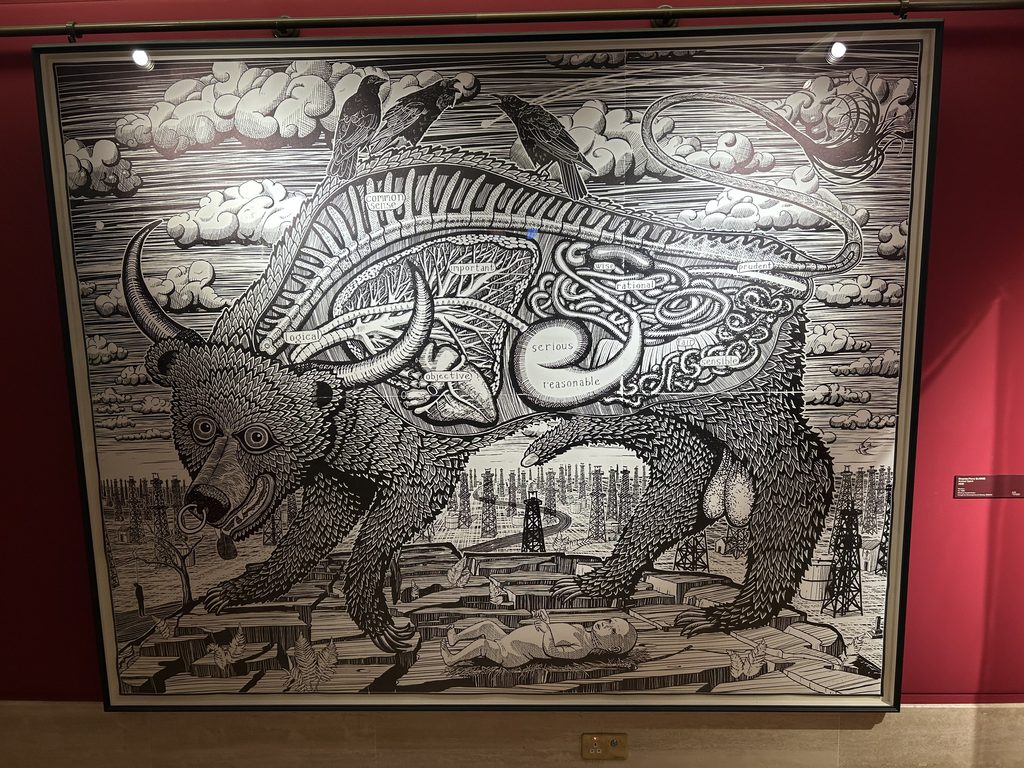
This is a wonderfully provocative work because it presents finance not as a sophisticated, orderly system of rational calculation, but as a grotesque, contradictory creature whose claims to reason coexist with destruction, power and moral blindness.
Perry is exposing the difference between the language through which finance legitimises itself and the consequences of finance in the real world.
The artwork can be read almost as a visual critique of the assumptions underlying modern financial science.
1. The monster: Finance as a creature of contradictions
The dominant image is an enormous hybrid animal, part bear, part bull, part dragon and part mechanical construction.
This is important because finance often presents itself through elegant mathematical models, orderly markets and rational economic agents.
Perry instead presents something monstrous, unstable and difficult to classify.
The animal’s body contains competing elements, suggesting that finance is not one coherent system but an accumulation of conflicting interests, institutions, beliefs and practices.
The bull and bear associations are particularly significant. They evoke the familiar language of rising and falling financial markets.
But Perry transforms these familiar market symbols into a single terrifying organism.
The bull and bear are no longer simply market conditions. They have become parts of a system that dominates the human world.
2. The language of reason conceals the violence of finance
Look closely at the words embedded in the creature:
- Logical
- Objective
- Rational
- Reasonable
- Sensible
- Prudent
- Wise
- Fair
- Serious
- Common sense
These are the virtues finance claims for itself.
They are also the vocabulary through which financial expertise establishes authority.
Yet Perry places these reassuring words inside a threatening creature.
The contrast is deliberate and satirical.
A financial institution can describe a decision as prudent while that same decision produces devastating consequences for workers, communities or the environment.
A valuation can be mathematically logical while resting on morally questionable assumptions.
A financial market can operate according to accepted rules while generating outcomes that many people regard as profoundly unfair.
The critical distinction is between internal rationality and external responsibility.
A decision may be rational according to a particular model without being wise when judged against the full circumstances of human life.
3. The monster’s anatomy: An illusion of coherence
The creature’s interior resembles an elaborate system of organs, tubes, patterns and interlocking structures.
This suggests wholeness, complexity, specialisation and interdependence.
Modern finance has become extraordinarily sophisticated, with derivatives, structured products, risk models, securitisation, institutional investment and elaborate accounting systems.
Yet complexity does not guarantee wisdom.
Indeed, complexity can make responsibility harder to locate.
One department designs a product. Another sells it. Another models the risk. Another finances it. Another audits it.
Each part may claim to have performed its specialised task correctly.
But who is responsible for the consequences of the whole system?
Perry’s monstrous anatomy can be interpreted as a visual metaphor for this fragmentation.
Finance has developed sophisticated organs of calculation without necessarily developing an equally sophisticated collective conscience.
4. The oil wells: Finance, extraction and ecological destruction
The background is filled with what appear to be oil derricks and industrial infrastructure.
This is one of the strongest visual contrasts in the painting.
The creature is surrounded by the machinery of resource extraction.
Finance is not simply about trading abstract securities. It allocates capital, shapes industrial development and influences the exploitation of natural resources.
The oil landscape links financial power to the material economy and environmental consequences.
The image challenges the comforting idea that finance is merely an intermediary.
Financial institutions can help make destructive activities possible, profitable and scalable.
The question becomes:
Can finance call itself prudent when its profitability depends on ecological damage that its models fail to account for adequately?
This interpretation is particularly relevant to debates about fossil-fuel investment, stranded assets and intergenerational responsibility. Contemporary research on financialisation exposes the deeply extractive nature of finance.

5. The abandoned baby and the hanging man: The human cost of financial abstraction
At the bottom of the image lies a naked, vulnerable human figure. On the left, a small figure hangs from a barren tree.
These are not incidental details.
Perry explains that he borrowed such imagery from the dramatic names of Japanese candlestick-chart patterns used by financial traders, including Abandoned Baby, Hanging Man, Three Black Crows and Dark Cloud Cover.
This is perhaps the artwork’s most brilliant irony.
Words describing human tragedy become technical terms in financial-market analysis.
A hanging man is no longer necessarily understood as a suffering person. He becomes a pattern on a trading chart.
An abandoned baby becomes a possible market signal.
Perry is exploiting this extraordinary linguistic contradiction.
My further interpretation is that the vocabulary of human suffering has been appropriated by financial technique while the actual suffering of human beings becomes peripheral to financial decision-making.
That interpretation is especially relevant to your critique of abstraction and epistemic violence.
6. Masculinity, power and the denial of emotion
The work is titled Animal Spirit (2016), and its original meaning is even more specific than the visual symbolism alone suggests.
Perry developed the work following conversations with financial professionals for his television series ‘Grayson Perry: All Man’.
He was particularly interested in the masculine culture of finance and its tendency to represent financial decisions as detached, objective and rational.
He described the creature as an irrational beast governing markets, deliberately combining the bull and the bear into a masculine figure.
His criticism was that the 2008 financial crisis revealed the emotional character of markets despite claims of rationality.
The monster’s exposed genitals reinforce the gendered symbolism.
Perry is not simply criticising greed.
He is asking why an industry shaped by competition, fear, excitement, status, pride and power can describe itself as operating beyond emotion.
The contradiction is not that finance contains emotions. It is that financial authority can deny the emotions and cultural assumptions shaping its own behaviour.
7. The birds, dark clouds and threatening landscape
The three dark birds perched on the creature contribute to the ominous atmosphere.
Their presence also connects to candlestick terminology, particularly Three Black Crows.
The landscape appears fractured, depleted and almost lifeless.
This reinforces a sense that the financial monster operates within a damaged world, yet remains enormous and powerful.
The animal dominates the composition; human beings are tiny.
That difference in scale can be interpreted as an expression of the imbalance between financial institutions and the people affected by their decisions.
The creature possesses immense power but no visible capacity for compassion.
8. The deeper paradox: Finance’s faith in its own rationality
Here is where the artwork becomes particularly interesting for my work on Organic Finance.
Perry appears to challenge the belief that financial markets operate as neutral mechanisms governed by objective calculation.
Finance often regards faith and belief as belonging to religion, culture or private life.
Yet finance itself depends upon beliefs:
- That markets process information efficiently.
- That prices convey meaningful knowledge.
- That mathematical models adequately represent risk.
- That competition produces desirable outcomes.
- That growth and returns indicate economic success.
- That financial expertise deserves authority.
These propositions vary in their empirical support and are not all articles of unquestioning faith.
Nevertheless, they can become institutional assumptions that professionals rarely examine.
Perry’s monster suggests that financial rationality can itself become a cultural belief system, especially when its practitioners cease questioning its limitations.

9. How the artwork connects to the book Organic Finance
| Perry’s visual critique | Organic Finance response |
|---|---|
| The monster claims rationality | Finance must recognise the limits of rational calculation |
| Human beings are marginalised | Restore human experience and dignity to financial judgement |
| The creature embodies masculine power | Examine culture, gender, hierarchy and institutional incentives |
| Financial language disguises consequences | Reconnect financial narratives and numbers to lived reality |
| The landscape is environmentally depleted | Make ecological responsibility integral to finance |
| The system appears uncontrollable | Develop reflexivity, accountability and stewardship |
| The animal contains contradictions | Embrace plurality and examine competing perspectives |
There is also an important difference.
Perry’s artwork is principally a satire and exposure of contradictions.
Organic Finance aspires to offer a constructive alternative: a way of organising financial knowledge and practice around culture, relationships, pluralism, conscience and responsibility.
Art reveals the problem in ways that a conventional financial model cannot.
But institutional reform requires taking the next step: translating that insight into education, governance, research and practice.
10. Why this artwork belongs in every finance classroom
I would use Animal Spirit at the very beginning of a corporate finance or financial markets course.
Show the artwork before introducing financial models.
Ask students:
- Why are words such as rational, objective and prudent embedded inside a monster?
- Why is the human being so small compared with the financial creature?
- What do the abandoned baby and hanging man reveal about financial language?
- Can a market be technically efficient but morally destructive?
- What does the artwork reveal that a financial textbook might conceal?
Then introduce the formal theory of financial markets.
This reverses the conventional educational sequence.
Instead of students learning financial models first and questioning their assumptions later, they begin by recognising that finance is a human institution shaped by culture, emotion, power and competing purposes.
My overall interpretation
Grayson Perry’s Animal Spirit is a powerful artistic critique of the self-image of financial science.
It exposes the contradiction between finance’s claims of objectivity and the emotional, cultural, gendered and institutional forces shaping its behaviour.
The 2008 financial crisis provides its historical context, but its significance extends beyond that event.
The work asks whether financial expertise can become so confident in its own methods that it loses sight of the human and ecological realities it is supposed to serve.
Its greatest achievement is to creatively make the invisible assumptions of finance visible.
And this leads to a particularly strong conclusion:
Finance has constructed a language of rationality that can conceal its own irrationality, a language of prudence that can legitimise destruction, and a language of objectivity that can disguise power. It has abandoned art altogether as a way of understanding human beliefs and customs, and led us to deny the simple fact that finance is purely a human construct – no other species needs finance for its survival or existence.
Perry exposes these contradictions through art. Organic Finance seeks to confront them through a different understanding of financial knowledge and responsibility.