
PROFESSOR ATUL K. SHAH www.atulkshah.co.uk
Globally renowned expert advisor and broadcaster on culture, accounting, finance, business ethics, holistic education and leadership
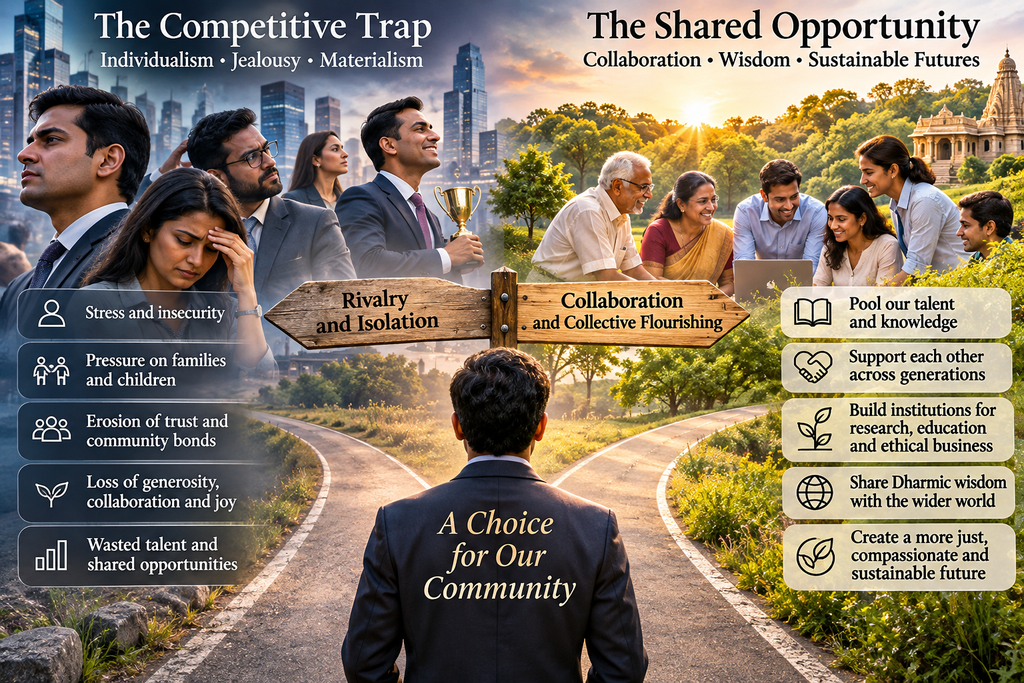
Why jealousy, competition and materialism threaten our collective wisdom, relationships and sustainable future
The paradox of a talented community
Indian diaspora communities possess extraordinary reservoirs of talent, enterprise, education, cultural heritage and professional achievement. Across generations, families have invested heavily in education, business, careers and the advancement of their children. Many have built successful enterprises, charitable institutions, temples and professional networks while contributing significantly to their adopted societies.
Yet beneath these achievements lies a troubling paradox. Communities rich in individual talent can remain surprisingly poor in collective imagination and cooperation.
When success becomes primarily a matter of personal wealth, status, recognition and competitive achievement, talented individuals may begin viewing one another as rivals rather than collaborators. Jealousy, comparison, insecurity and suspicion can undermine relationships that might otherwise generate extraordinary social value.
These tendencies are not unique to Indian communities, nor are they universal within them. However, they deserve critical reflection wherever close-knit communities experience the pressures of competitive, materialist societies.
How materialism reshapes community values
Neoliberal capitalism places considerable emphasis on individual responsibility, competition, market performance and material achievement. These values can encourage initiative, innovation and enterprise. But when they dominate social life, they can also transform how people understand their own worth.
Success becomes measured through salaries, property, business valuations, professional titles and public recognition.
A neighbour’s achievement becomes a comparison.
A friend’s promotion becomes a reminder of one’s own position.
Another family’s prosperity becomes a source of anxiety rather than celebration.
Gradually, relationships become competitive rather than cooperative.
The tragedy is that people may possess considerable material wealth while experiencing emotional insecurity and relational poverty.
Jealousy is especially destructive because it converts another person’s success from a shared opportunity into a perceived personal threat.
The hidden damage to individuals
Living through constant comparison carries a substantial psychological cost.
Individuals may become reluctant to celebrate others, share ideas or acknowledge their own vulnerabilities. They may fear losing status, influence or recognition.
Successful people can become isolated because others perceive them as competitors. Creative individuals may withdraw from community activities when their contributions attract criticism rather than encouragement.
Over time, this weakens trust and generosity.
People begin protecting their reputations rather than developing their potential.
Instead of asking, “What can I contribute?” they ask, “How will others judge me?”
The result is a loss of freedom, authenticity and joy.
Families inherit the competition
The consequences extend into family life.
Children may grow up surrounded by comparisons concerning examination results, university admissions, careers, marriages and material possessions.
Achievement becomes an obligation rather than an opportunity for self-discovery.
Parents may unintentionally communicate that their children’s success determines family prestige.
Young people can consequently develop anxiety about failure, difficulty expressing individuality and uncertainty about their intrinsic worth.
Family relationships may become strained when expectations override empathy.
Even intergenerational wisdom can be weakened when elders emphasise material achievement more strongly than character, compassion and meaningful relationships.
A community may successfully transmit wealth while failing to transmit wisdom.
The erosion of community capital
Close-knit communities possess assets that conventional economics struggles to measure.
Trust, voluntary service, cultural memory, relationships, spiritual wisdom, professional expertise, entrepreneurial experience and intergenerational networks represent enormous collective resources.
Yet these resources flourish only through cooperation.
When jealousy and factionalism dominate, community organisations become arenas for personal recognition rather than public service.
Leadership positions may become symbols of prestige.
Talented volunteers may feel excluded.
Independent thinkers may be marginalised.
Younger generations may disengage.
The community then loses precisely the people capable of renewing its institutions.
This represents a profound destruction of social and moral capital.
The greatest loss is not financial. It is the disappearance of possibilities that collective action could have created.
The opportunities we are losing
Imagine what could emerge if Indian diaspora communities deliberately pooled their intellectual, financial, cultural and professional resources.
They could establish independent research and training institutions exploring Dharmic wisdom, ethical business and sustainability.
They could mentor thousands of young people, support entrepreneurs, preserve endangered cultural knowledge and create innovative responses to loneliness, ecological degradation and inequality.
They could bring together scholars, business leaders, artists, healthcare professionals and community organisers to address pressing social challenges.
Their accumulated experience across different civilisations could become an extraordinary source of international learning.
Instead of competing for recognition within existing institutions, communities could create new institutions that serve humanity.
The opportunity cost of rivalry is therefore not merely damaged relationships. It is the sustainable future we fail to build together.
Recovering Dharmic wisdom
Dharmic traditions offer powerful resources for challenging destructive individualism.
Jain anekāntavāda encourages humility and recognition of multiple perspectives.
Ahimsa extends non-violence beyond physical conduct into attitudes, speech and relationships.
Aparigraha questions excessive attachment to possessions, status and accumulation.
Seva reminds us that service is a responsibility rather than an opportunity for self-promotion.
These principles invite a different understanding of achievement.
Another person’s success need not diminish our own.
Knowledge grows through sharing.
Compassion expands through practice.
Communities become stronger when talent is cultivated rather than controlled.
Such wisdom must also be practised critically. Religious identity alone does not guarantee ethical conduct; communities must confront their own hierarchies, exclusions and rivalries.
From individual success to collective flourishing
The challenge is not to suppress ambition or individual excellence. Both are valuable.
It is to redefine success so that personal achievement strengthens collective wellbeing.
We need community leaders who celebrate talent without feeling threatened by it, philanthropists who invest in independent scholarship, professionals who mentor without expecting rewards, and institutions that welcome constructive criticism.
Above all, we need to cultivate the capacity to rejoice genuinely in the achievements of others.
A flourishing community is not one in which everyone becomes equally successful. It is one in which everyone’s potential is respected and collective resources are used wisely.
Conclusion: The future we could build together
The Indian diaspora has already demonstrated remarkable capacity for enterprise, resilience and adaptation.
Its next great achievement could be the transformation of individual accomplishment into collective wisdom.
In an increasingly fragmented and materialist world, communities grounded in ethical traditions have an opportunity to demonstrate that prosperity need not destroy compassion, ambition need not generate jealousy, and excellence need not produce exclusion.
The true measure of a community is not how many successful individuals it produces, but how effectively those individuals work together to create a more humane, generous and sustainable world.
Our greatest inheritance is not wealth alone.
It is the wisdom to share it, the humility to celebrate others, and the imagination to build something greater than ourselves.
PRACTICAL TIPS
- Be generous in complimenting others
- Dont compare your kids to others
- Build your own inner security and self-pride
- Value the importance of self-awareness and self-confidence
- Use faith to dispel fear, anxiety and competitive stress
- Always think of something positive to say when you meet people