
PROFESSOR ATUL K. SHAH www.atulkshah.co.uk
Globally renowned expert advisor and broadcaster on culture, accounting, finance, business ethics, holistic education and leadership
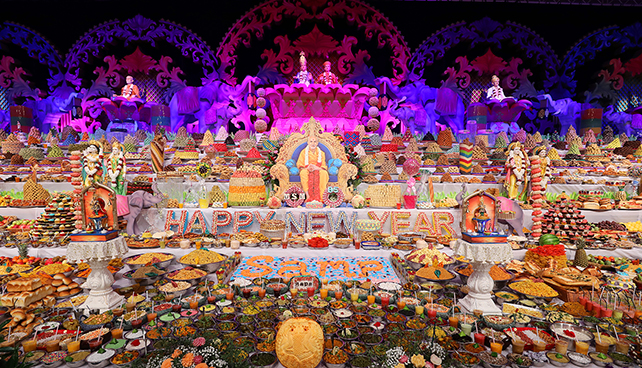
Above picture was taken at Diwali, Neasden Hindu Temple, London
Indian wisdom is theoretically strong because it is not merely a collection of spiritual sayings or religious customs. Across Hindu, Jain, Buddhist and other Indic traditions, there are highly developed theories of knowledge, mind, action, ethics, language, causation, social order, political economy and human flourishing.
The first point is therefore one of vocabulary. There is no single “Indian wisdom.” There are competing schools, arguments and intellectual traditions. Their strength comes partly from this plurality.
A useful summary is:
Indian intellectual traditions are theoretically strong because they developed systematic answers to foundational questions that modern social science often treats only partially: What is a person? What motivates action? What constitutes knowledge? What is a good life? How should desire be governed? What makes authority legitimate? What obligations arise from interdependence?
Several features explain this strength.
1. A richer theory of the human being
Much modern economics starts with preferences, incentives and rational choice. Indian traditions often begin much deeper—with desire, attachment, consciousness, intention, habit, ego, suffering and self-discipline.
Jain thought analyses anger, pride, deceit and greed. Buddhism examines craving and attachment. Yoga traditions analyse fluctuations of mind and disciplined attention. The Bhagavad Gītā asks how action can be undertaken without destructive attachment to results.
This creates a much richer theory of economic behaviour.
Instead of asking only:
“What incentive will make someone act differently?”
Indian traditions also ask:
“What kind of person is being formed?”
That is theoretically powerful for business because organisations do not merely allocate incentives—they cultivate character.
2. Sophisticated Epistemology
Indian philosophy contains some of the world’s longest traditions of systematic debate about how we know what we know.
Nyāya developed detailed theories of perception, inference, testimony and reasoning.
Mīmāṃsā developed sophisticated approaches to interpretation and authoritative knowledge.
Buddhist philosophers analysed perception, cognition and conceptual construction.
Jain philosophy developed Anekāntavāda and Syādvāda: reality may require examination from several legitimate standpoints.
For modern business science, this is highly relevant.
Finance often seeks:
one valuation, one risk number, one model, one forecast.
Jain epistemology warns:
A complex reality may be true from several perspectives without collapsing into relativism.
That has obvious applications to stakeholder analysis, sustainability and risk.
3. Ethics is built into theories of action
Modern social science often separates positive analysis from normative questions.
Indic traditions generally do not make such a sharp separation.
Action has consequences.
Intent matters.
Character matters.
Relationships matter.
For Jainism, Ahimsa, Satya, Asteya and Aparigraha are not external ethical rules added onto economic behaviour. They transform the meaning of economic action itself.
Similarly, Dharma asks whether action is appropriate within a wider network of duties and responsibilities.
This gives Indian traditions a theory of embedded economics rather than economics detached from morality.
4. A sophisticated theory of desire
This may be one of their greatest contemporary strengths.
Modern economics frequently takes wants as given.
Indian wisdom repeatedly interrogates wants themselves.
Jain Aparigraha asks about attachment and limits.
Buddhist thought examines craving.
Yogic traditions cultivate restraint.
The puruṣārtha framework places artha—material prosperity—inside a wider conception of life.
That permits a question contemporary economics struggles to ask:
When does enough become enough?
That question becomes critically important under ecological limits.
5. Theories of Interdependence
Modern economic modelling often begins with individuals.
Many Indic traditions begin much closer to relationality.
Buddhist dependent origination rejects radically isolated existence.
Jain ideas of interconnected living beings make harm relational.
Dharma itself frequently situates the individual inside multiple relationships and duties.
This is important theoretically because modern economics often treats consequences as “externalities.”
A relational ontology asks whether they were ever genuinely external.
Pollution, labour exploitation and ecological degradation appear differently when the economy is understood as nested within society and nature.
6. Inner Governance
Modern governance is predominantly external:
rules → monitoring → incentives → sanctions.
Indian traditions add:
self-restraint → awareness → discipline → character.
This is a radically important complement.
Regulation cannot watch everyone continuously.
Contracts cannot specify everything.
Professional standards cannot eliminate greed.
Economic systems therefore depend upon people regulating themselves.
Indic traditions developed extensive technologies of self-governance:
- meditation;
- fasting;
- vows;
- confession and reflection;
- restraint;
- ethical disciplines;
- self-observation.
Modern management science has comparatively little theory of such inner governance.
7. Theory and practice are deliberately connected
Another strength is that philosophy was often not conceived merely as intellectual argument.
Ideas were connected with practices.
Ahimsa became diet and conduct.
Aparigraha became restraint.
Forgiveness became ritual.
Meditation trained attention.
Pilgrimage embodied discipline.
Fasting interrupted consumption.
This is theoretically significant because it creates a chain:
idea → practice → habit → character → institution → culture
Modern business ethics frequently stops at the first two stages: principles and codes.
Indic traditions understand that values have to become habitual.
8. Sophisticated theories of political economy
Indian thought is not simply spiritual.
The Arthaśāstra, for example, contains systematic analysis of:
- taxation;
- administration;
- trade;
- corruption;
- intelligence;
- regulation;
- public finance;
- political power.
Merchant traditions developed practices around credit, trust, community organisation and philanthropy.
Dharma literature grappled with property, obligation, governance and social order.
So there is a substantial indigenous archive of economic and institutional thinking that is often underestimated when “Indian wisdom” is reduced to spirituality.
9. Indian traditions understand plural forms of wealth
This connects strongly with your Jain Capital Ecology idea.
Modern economics privileges financial capital.
Indian civilisational traditions recognise wealth in much broader forms:
knowledge, relationships, character, family, reputation, community, spirituality, service and cultural inheritance.
A guru may possess little financial capital but enormous knowledge capital.
An ascetic may possess almost nothing materially but enormous moral authority.
A merchant family may inherit relationships and reputation alongside money.
A temple may preserve cultural, artistic, social and spiritual capital across centuries.
This produces a richer theory of prosperity.
10. Long temporal horizons
Modern business is dominated by:
quarter → year → investment cycle.
Indian traditions frequently situate conduct across much longer horizons.
Karma encourages attention to consequences.
Civilisational memory links generations.
Pilgrimage and ritual reconnect present action with deep historical time.
Family enterprises may understand themselves intergenerationally rather than transactionally.
This makes Indian wisdom unusually compatible with questions of stewardship and sustainability.
11. Integrated Knowledge
Modern universities divide:
economics | psychology | philosophy | religion | ecology | management.
Indian intellectual traditions frequently connected these questions.
A discussion of wealth could simultaneously involve:
- psychology of desire;
- moral responsibility;
- family obligation;
- political order;
- spiritual development;
- ecological restraint.
That integrative quality is particularly valuable today because problems such as climate change, inequality and financial instability do not respect academic departmental boundaries.
12. Traditions of argument rather than simple obedience
Indian traditions were internally contested.
Buddhists argued with Brahmanical philosophers.
Jains developed critiques of absolutist truth claims.
Nyāya philosophers disputed Buddhists.
Vedānta itself contains strongly divergent schools.
This makes “Indian wisdom” intellectually interesting precisely because it contains argument, counterargument and competing ontologies.
It is not simply inherited authority.
Why is this especially relevant to business science?
Because many weaknesses of contemporary business theory arise precisely where Indian traditions are strongest:
| Business science often emphasises | Indian wisdom can contribute |
|---|---|
| Incentives | Character |
| Preferences | Desire and attachment |
| Regulation | Self-regulation |
| Shareholder value | Dharma and responsibility |
| Growth | Sufficiency |
| Individual agency | Interdependence |
| Measurement | Meaning |
| One model | Multiple perspectives |
| Financial capital | Multiple capitals |
| Compliance | Conscience |
| Quarterly time | Intergenerational time |
| Technical knowledge | Wisdom and judgement |
The point is not that the second column should replace the first.
The intellectually interesting possibility is dialogue between them.
But the traditions should not be romanticised
Theoretical sophistication does not mean historical practice was always admirable.
Indian societies have also contained:
- caste hierarchy;
- gender inequality;
- inherited privilege;
- economic exclusion;
- religious conflict;
- authoritarian traditions.
Nor are all ancient theories compatible with contemporary evidence or democratic values.
Therefore the serious scholarly proposition is not:
“Indian wisdom has all the answers.”
It is:
“Indian intellectual traditions contain unusually rich theoretical resources that deserve to be treated as interlocutors in global social science rather than merely as cultural objects.”
That distinction is crucial.
The biggest loss from excluding them is therefore not simply the exclusion of Indian voices.
It is the loss of alternative theoretical imagination.
When only one intellectual tradition defines concepts such as rationality, value, wealth, progress, agency and prosperity, social science mistakes a culturally particular worldview for a universal one.
Indian wisdom is theoretically powerful precisely because it can reopen those foundational questions.
And for business and finance, perhaps its most radical question is remarkably simple:
Before asking how efficiently wealth can be created, ask what wealth is, what it is for, what it does to the human being, and what responsibilities arise from possessing it.
That is not peripheral to business theory.
It goes to its foundations.