
PROFESSOR ATUL K. SHAH www.atulkshah.co.uk
Globally renowned expert advisor and broadcaster on culture, accounting, finance, business ethics, holistic education and leadership
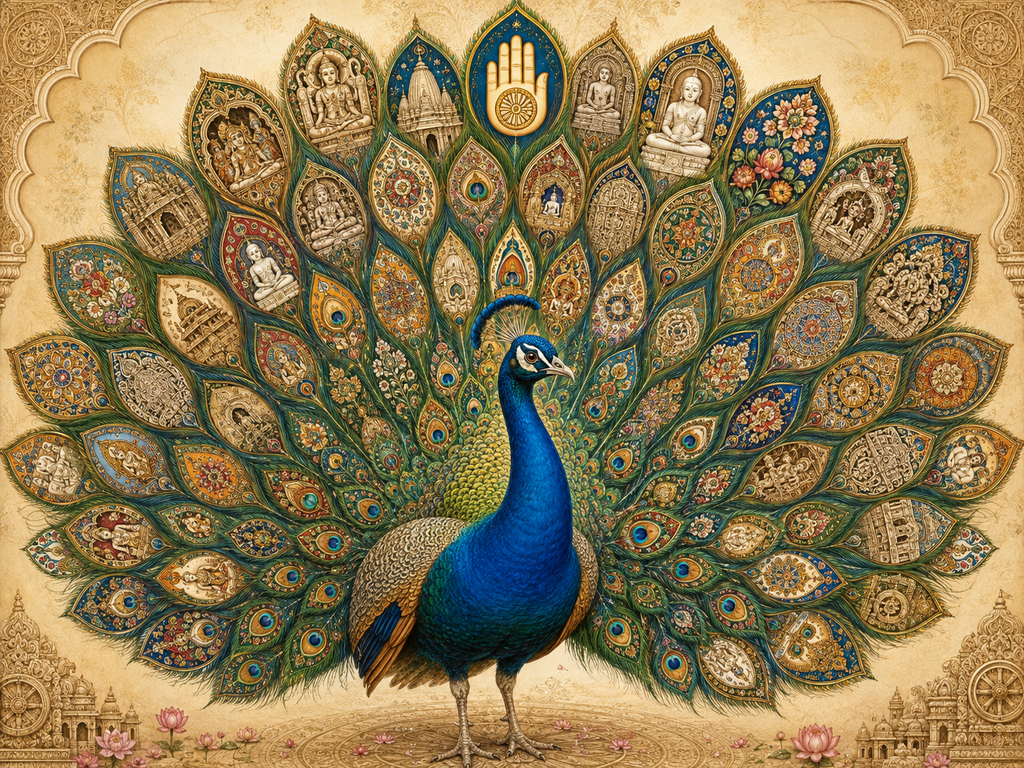
The Jains have a highly sophisticated plurality of capitals which help shape their conduct and attitudes to wealth creation and distribution
Introduction
Modern business science has become extraordinarily sophisticated in measuring financial capital while remaining surprisingly primitive in understanding many of the forms of wealth that make economic life possible.
Balance sheets measure cash, debt, inventories, property and increasingly intellectual property. Finance theory models returns, risk and capital structure. Economics analyses incentives, prices and productivity. Management studies have broadened the vocabulary to include human, intellectual, social and organisational capital. Yet much of the wealth that sustains families, communities, businesses and civilisations remains poorly conceptualised, weakly measured and frequently invisible.
Jain commercial experience offers a particularly revealing challenge to this narrowness.
Across many centuries and different geographical settings, Jain communities have built businesses, professions, philanthropic organisations, temples, schools, charities, diaspora institutions and extensive networks of mutual support. Jain economic ethics places particular emphasis upon Ahimsa, Satya, Asteya, restraint, self-discipline, responsibility and interdependence. Contemporary scholarship has consequently identified trust, relationships and moral character as important elements of Jain economic life rather than viewing commercial success as a purely financial phenomenon.
What becomes visible from this perspective is not one alternative form of capital, but an entire ecology of capitals.
Consider the following:
knowledge capital, cultural capital, relationship capital, moral capital, community capital, diaspora capital, spiritual capital, voluntary capital, faith capital, vision capital, thrift capital, family capital, creative capital, public service capital, heritage capital, experiential capital, training capital, saving capital and entrepreneurial capital.
These capitals overlap. Some can be converted into others. Some reside primarily in individuals; others belong to families, networks, institutions or communities. Some accumulate slowly over generations and can be destroyed rapidly. Some generate financial returns, while others constrain financial behaviour for moral purposes.
Their importance extends well beyond Jain communities. They expose a fundamental weakness in contemporary business science: economic systems rely upon reservoirs of social, cultural and moral wealth that conventional accounting and finance largely consume without adequately recognising, replenishing or protecting them.
The conceptual problem with “capital”
The language of multiple capitals is not entirely new. Pierre Bourdieu famously distinguished economic, social and cultural capital, later associating these with symbolic capital and power. Social capital was subsequently developed in different directions by James Coleman, Robert Putnam, Nan Lin and others. Although their approaches differ, relationships, trust, networks, norms and access to collective resources became recognised as economically consequential.
Bourdieu’s insight was especially important because capital could be converted. Social relationships could generate economic opportunities; cultural knowledge could produce status; economic wealth could purchase access to cultural resources. He therefore challenged the idea that wealth existed only in monetary form.
Later multi-capital frameworks have added natural, human, institutional, intellectual, organisational, psychological, moral and spiritual capitals. Recent organisational scholarship similarly argues that economic, cultural and social capital alone do not adequately explain power and capability within organisations, adding knowledge, reputation, organisational and institutional capital.
Yet something important remains missing.
Business research usually treats these additional capitals as supplements to financial capital. The underlying economic ontology is rarely changed. Financial capital remains primary, while culture, relationships, morality and spirituality become useful resources that enhance productivity, competitiveness or resilience.
The Jain perspective suggests almost the opposite:
Financial capital is itself dependent upon deeper reservoirs of moral, cultural, relational and community capital.
Markets need trust.
Contracts need honesty.
Enterprise needs imagination.
Families transmit discipline.
Communities generate reputation.
Faith can create restraint.
Volunteers sustain institutions.
Heritage provides identity.
Diasporas transport relationships.
Savings enable patient investment.
Experience produces judgement.
These are not marginal to economic life. They constitute much of its invisible infrastructure.
A Jain Ecology of Capitals
1. Knowledge Capital
Knowledge capital consists of accumulated understanding that enables people and communities to act intelligently.
Business science often reduces knowledge capital to technical competencies, intellectual property, patents or organisational know-how. Jain knowledge traditions suggest something broader: knowledge can include commercial intelligence, ethical judgement, family memory, regional expertise, linguistic knowledge, community understanding and awareness of human character.
A merchant may know:
- whom to trust;
- which customer is temporarily distressed rather than unreliable;
- how a particular market behaves;
- where reputation matters more than price;
- when expansion would become excessive;
- how to negotiate without humiliating another party.
Much of this knowledge is tacit.
It cannot easily be placed into a spreadsheet.
And because it accumulates through experience and relationships, it is often transferred through apprenticeship rather than textbooks.
2. Cultural Capital
Cultural capital is one of the better-established concepts in social science. Bourdieu distinguished embodied cultural competencies, objectified cultural goods and institutionalised forms such as qualifications.
But Jain cultural capital extends beyond education and taste.
It includes:
- language;
- narratives;
- ritual;
- business customs;
- attitudes to wealth;
- dietary disciplines;
- expectations of reputation;
- inherited understandings of duty;
- shared concepts such as Ahimsa and Aparigraha.
Culture gives economic conduct meaning.
Two people may possess the same financial wealth but interpret its purpose very differently according to the cultures in which they live.
Cultural capital therefore shapes not merely how wealth is accumulated, but what wealth is for.
3. Relationship Capital
Relationship capital consists of durable ties of trust, reciprocity, familiarity and obligation.
This is closely related to social capital, but deserves separate attention in business because relationships themselves can become economic infrastructure.
Long-term suppliers may provide flexibility during difficulty.
Customers may remain loyal despite temporary disadvantages.
Relatives may introduce trusted partners.
Community reputation may reduce the need for costly formal verification.
Jain economic writing has emphasised precisely this accumulation of trust and relationship capital across generations.
Relationship capital cannot simply be bought.
It must be cultivated.
And once betrayed, it can disappear extraordinarily quickly.
4. Moral Capital
Moral capital consists of accumulated credibility arising from perceived honesty, fairness, restraint, responsibility and character.
Its economic importance is considerable.
A business believed to keep promises possesses an asset even if accounting cannot recognise it.
A professional known to act honourably may receive opportunities unavailable to someone equally technically competent but distrusted.
A family respected over several generations can inherit reputational advantages that resemble inherited financial wealth.
Jain traditions are particularly revealing because moral conduct is not merely an economic strategy. It is connected with spiritual discipline and character formation.
This matters.
If morality is treated only as a technique for generating profit, moral capital eventually becomes instrumental and fragile.
Its deeper strength comes when integrity is regarded as intrinsically valuable.
5. Community Capital
Community capital consists of institutions, norms and capacities through which groups cooperate.
It includes temples, associations, schools, charities, business groups, social networks, dispute-resolution practices and community leadership.
Putnam’s conception of social capital emphasises trust, norms and civic networks that facilitate cooperation, while other traditions distinguish bonding and bridging forms of social capital.
Jain community capital can similarly be both powerful and problematic.
It can support:
- newcomers;
- entrepreneurs;
- families in distress;
- educational advancement;
- philanthropy;
- cultural transmission.
But strong community capital can also become exclusionary.
Insiders may receive privileges unavailable to outsiders.
Networks may protect elites.
Conformity may suppress dissent.
The concept must therefore remain critical rather than celebratory.
6. Diaspora Capital
Diaspora capital is the accumulated capacity created when communities maintain networks across borders.
Migrants do not necessarily leave their social infrastructure behind.
They may carry:
- family connections;
- languages;
- trading knowledge;
- religious institutions;
- reputational systems;
- professional networks;
- philanthropic obligations.
Diaspora capital can therefore create bridges between local and global markets.
For Jain communities in East Africa, Britain, North America and elsewhere, the capacity to establish institutions while retaining transnational links has often been a major source of resilience.
Diaspora capital is much richer than remittances.
It is portable social infrastructure.
7. Spiritual Capital
Spiritual capital concerns the resources generated by meaning, self-understanding, transcendence, purpose and inner discipline.
Contemporary multi-capital research has begun to recognise spiritual capital explicitly, including religious belief and the sources from which people derive meaning.
In Jainism, spiritual capital may arise from:
- meditation;
- self-restraint;
- fasting;
- reflection;
- awareness of karma;
- detachment;
- compassion;
- disciplined conduct.
Its economic relevance is indirect but potentially profound.
A person able to restrain desire may behave differently from one whose identity depends upon continuous accumulation.
Spiritual capital can therefore create an inner boundary on economic behaviour.
8. Voluntary Capital
Voluntary capital is the accumulated capacity generated through unpaid service.
Communities frequently depend upon individuals who:
- organise events;
- run charities;
- teach children;
- serve on committees;
- raise funds;
- visit the vulnerable;
- maintain institutions;
- organise festivals;
- provide professional skills without payment.
Economics often records this contribution poorly because no market transaction occurs.
Yet remove voluntary labour and vast areas of civic and religious life would collapse.
Voluntary capital demonstrates one of the deepest limitations of market valuation:
What has no price may still have enormous value.
9. Faith Capital
Faith capital overlaps with spiritual capital but is more institutional and collective.
It arises from shared belief, ritual, moral narrative and religious belonging.
Faith can produce:
- trust;
- obligation;
- sacrifice;
- generosity;
- identity;
- discipline;
- continuity.
It can also provide moral boundaries around economic behaviour.
The mistake of secular business analysis is not simply that it ignores religion. It often assumes that religious motivation is private and irrelevant to economic decision-making.
Yet in many societies faith has historically shaped attitudes toward lending, generosity, consumption, work, ownership and responsibility.
Ignoring faith therefore means ignoring a significant generator of economic behaviour.
10. Vision Capital
Vision capital is the capacity to imagine futures that do not yet exist.
Entrepreneurs possess it.
Reformers possess it.
Religious leaders possess it.
Artists possess it.
Communities also possess collective visions about the future they wish to create.
Modern finance often discounts such capacity because vision cannot easily be quantified before results appear.
Yet almost every transformative institution begins in imagination.
Vision capital therefore precedes much financial capital.
Someone must first imagine the enterprise worth financing.
11. Thrift Capital
Thrift capital consists of habits that prevent unnecessary depletion of resources.
It includes:
- careful consumption;
- repair;
- avoidance of waste;
- modest living;
- disciplined spending;
- respect for resources.
Thrift differs from simple financial saving.
It is a cultural disposition.
A family that practises thrift builds resilience because its standard of living does not automatically rise with every increase in income.
Jain ideas of restraint and Aparigraha can reinforce such behaviour.
In an era of ecological crisis, thrift capital deserves renewed attention because sustainability requires not merely greener production but limits on consumption.
12. Family Capital
Families accumulate extraordinary forms of capital.
They transmit:
- values;
- habits;
- reputations;
- contacts;
- knowledge;
- language;
- emotional support;
- financial resources;
- professional expectations.
Social capital scholarship has long recognised the role of family in transmitting resources and capabilities across generations.
In Jain business families, family capital can include commercial mentoring, patient finance, inherited trust and international connections.
But again, this is not automatically benign.
Family capital can become nepotism.
Inheritance can reproduce inequality.
Patriarchal structures can exclude women.
A critical account therefore asks not merely how family capital is accumulated, but who controls it and who benefits from it.
13. Creative Capital
Creative capital is the capacity to imagine, improvise and combine resources in new ways.
Business science frequently associates creativity with innovation, but creativity is broader.
Jain communities historically transformed commercial prosperity into:
- architecture;
- sculpture;
- manuscripts;
- music;
- pilgrimage infrastructure;
- philanthropy.
Creativity converts resources into cultural meaning.
This reminds us that business success can generate not merely more business, but art, beauty and collective memory.
14. Public Service Capital
Public service capital consists of accumulated credibility, networks and experience created through service to the wider society.
It develops when individuals devote time and expertise to:
- civic institutions;
- education;
- healthcare;
- charities;
- professional bodies;
- local government;
- social reform.
Public service produces knowledge of society that commercial activity alone cannot generate.
It can also create legitimacy.
But this too requires critical scrutiny: public service should not become merely another method through which wealthy elites accumulate prestige and access.
15. Heritage Capital
Heritage capital consists of inherited cultural resources that connect present communities with previous generations.
It includes:
- buildings;
- temples;
- manuscripts;
- archives;
- stories;
- rituals;
- art;
- pilgrimage sites;
- family histories.
Heritage is often treated as consumption—a museum or tourism asset.
But heritage can be productive.
It can generate identity, confidence, values and continuity.
For business families, knowledge of previous generations can produce a longer time horizon.
The question changes from:
What return can we generate this year?
to:
What kind of institution are we passing to the next generation?
That shift in temporal imagination can profoundly influence financial behaviour.
16. Experiential Capital
Experiential capital is accumulated judgement produced by having lived through events.
Someone who has survived:
- recessions;
- migration;
- inflation;
- business failure;
- political disruption;
- family succession;
- market bubbles
possesses knowledge that cannot be acquired simply through analytical models.
Modern business education often privileges formal expertise over lived experience.
This creates the paradox that young analysts with sophisticated quantitative tools can possess enormous technical authority while lacking experiential wisdom.
Experience is not infallible.
But neither should it be dismissed.
17. Training Capital
Training capital refers to accumulated practical capabilities produced by sustained learning.
This includes formal education but also:
- apprenticeship;
- mentoring;
- observation;
- repeated practice;
- professional formation.
Training capital becomes especially powerful when technical skill and moral formation remain connected.
Traditional apprenticeship did not simply teach how to perform a task.
It frequently transmitted how a responsible practitioner ought to behave.
Modern professional training has sometimes separated competence from character.
Reuniting them is essential.
18. Saving Capital
Saving capital is the accumulated capacity created through delayed consumption.
Savings provide:
- resilience;
- independence;
- investment capacity;
- patient capital;
- protection against shocks.
But saving capital is not simply a financial stock.
A culture of saving depends upon values.
It requires delayed gratification and confidence in the future.
High savings can therefore arise partly from cultural dispositions transmitted between generations.
This is another example of financial behaviour resting upon non-financial foundations.
19. Entrepreneurial Capital
Entrepreneurial capital is more than ownership of a business.
It combines:
- initiative;
- courage;
- judgement;
- opportunity recognition;
- networks;
- resilience;
- creativity;
- willingness to accept uncertainty.
Entrepreneurs draw upon nearly all the other capitals.
Family capital may provide early support.
Relationship capital provides customers.
Knowledge capital helps identify opportunities.
Diaspora capital opens markets.
Saving capital provides finance.
Moral capital creates trust.
Vision capital provides direction.
Entrepreneurial capital therefore illustrates the central thesis most clearly:
Economic capital is often the visible outcome of an invisible ecology of other capitals.
Capital Conversion: The Missing Dynamic
The most important question is not simply how many capitals exist.
It is how they convert into one another.
Bourdieu recognised this conversion problem early: economic, cultural and social resources can reinforce and reproduce one another.
Jain business history suggests much richer conversion chains:
faith → moral discipline → reputation → trust → relationships → commercial opportunity
or:
savings → entrepreneurial capital → financial surplus → philanthropy → community institutions → cultural capital
or:
diaspora networks → market knowledge → entrepreneurship → wealth → heritage patronage
or:
family → training → experiential knowledge → business capability → reputation → intergenerational continuity
These conversion chains are rarely captured in conventional financial analysis.
Yet they may explain business resilience more effectively than financial ratios alone.
Capital Accumulation Across Generations
Another critical difference concerns time.
Financial economics usually analyses capital within relatively short horizons.
But cultural and moral capital often take decades or generations to accumulate.
A family name may take fifty years to establish.
A community institution may take centuries.
A religious tradition may carry knowledge across millennia.
This creates a radical asymmetry:
Social and moral capital accumulate slowly but can be destroyed rapidly.
One scandal can destroy decades of trust.
One generation of neglect can weaken cultural transmission.
One period of excessive consumption can dissipate savings accumulated over decades.
This makes stewardship essential.
We should therefore think not only about capital accumulation but capital replenishment.
Capitals That Discipline Other Capitals
This is where the Jain perspective becomes especially distinctive.
Conventional economics usually assumes that more capital is advantageous.
But Jain ethics introduces the idea that certain capitals should discipline others.
Moral capital should restrain financial capital.
Spiritual capital should restrain acquisitive desire.
Community capital should place obligations upon private wealth.
Heritage capital should extend the time horizon.
Faith capital should remind entrepreneurs that financial success is not the highest human purpose.
Aparigraha is therefore profound from a capital perspective.
It says, in effect:
Capital must not become attachment.
The goal is not endless accumulation.
It is the wise stewardship of resources.
The Dark Side of Multiple Capitals
None of these capitals should be romanticised.
Social capital can become exclusion.
Family capital can become nepotism.
Cultural capital can reinforce hierarchy.
Diaspora capital can produce closed networks.
Faith capital can become dogmatism.
Heritage capital can become nostalgia.
Moral capital can be manipulated for reputation management.
Public service capital can become elite access.
Voluntary capital can exploit unpaid labour.
Bourdieu’s great contribution was precisely to show that non-financial capitals can reproduce privilege and social hierarchy rather than merely generating cooperation. Contemporary discussions increasingly reintroduce this question of power into social-capital analysis.
A serious Jain theory of capital must therefore ask:
Who possesses each capital?
Who controls access to it?
Who is excluded?
How is it inherited?
Can it be converted into economic privilege?
How is it replenished?
These questions prevent cultural analysis from becoming romantic sociology.
Why Business Science Misses So Much
Contemporary business science struggles with these capitals for several reasons.
First, measurement bias privileges what can easily be quantified.
Second, individualism obscures resources held collectively by families and communities.
Third, short-termism undervalues forms of wealth accumulated across generations.
Fourth, secularisation makes faith and spirituality difficult to incorporate into mainstream theory.
Fifth, disciplinary fragmentation separates economics, sociology, anthropology, religious studies, history and business.
Sixth, financialisation encourages the assumption that ultimately everything important should be translated into monetary value.
But monetising these capitals may actually misunderstand them.
The value of trust is not identical to the money it saves.
The value of faith is not merely its productivity effect.
The value of community is not simply its contribution to GDP.
The value of heritage cannot be reduced to tourist receipts.
Some forms of capital matter precisely because they establish limits upon market valuation.
Toward a Jain Multi-Capital Framework
A Jain-inspired framework could organise these capitals into six families.
Inner capitals
Spiritual, moral, experiential and vision capital.
Relational capitals
Relationship, family, community and diaspora capital.
Cultural capitals
Cultural, faith, heritage and creative capital.
Capability capitals
Knowledge, training and entrepreneurial capital.
Stewardship capitals
Thrift, saving, voluntary and public-service capital.
Financial capital
The monetary resources generated and mobilised through the interaction of all the above.
This could be visualised as an ecosystem rather than a balance sheet.
At its centre is character.
Around character sit relationships.
Around relationships sit community and culture.
From these emerge capabilities, entrepreneurship and stewardship.
Financial wealth is one output—but not the sole objective.
Implications for Accounting and Finance
This framework poses a major challenge to accounting.
Accounting asks:
What does the organisation own?
The multi-capital perspective asks:
What sustains the organisation?
Accounting asks:
What resources are controlled?
The wider framework asks:
Which resources have been inherited, borrowed from society or entrusted by future generations?
Finance asks:
What is the return on capital?
Jain wisdom asks:
Which capital? Return to whom? At what moral, cultural and ecological cost?
This is not an argument for inventing monetary values for every intangible asset.
Indeed, doing so could repeat the original problem.
Instead, organisations need plural accounting capable of recognising important resources without pretending they are commensurable.
Implications for Business Education
Business education should therefore teach students to identify multiple forms of capital in every enterprise.
When analysing a successful family firm, students should ask:
- What knowledge has accumulated?
- What relationships sustain it?
- What moral reputation does it possess?
- What family resources were inherited?
- What community infrastructure supports it?
- What savings made investment possible?
- What cultural dispositions encourage resilience?
- What forms of unpaid service sustain its environment?
This would fundamentally change how entrepreneurship is understood.
The heroic entrepreneur would give way to the socially embedded entrepreneur.
Conclusion: From Capital Monoculture to Capital Ecology
Jain experience reveals something fundamental about economic life.
Businesses do not grow from money alone.
They grow from:
knowledge, culture, relationships, morality, community, diaspora networks, spirituality, faith, vision, thrift, family, creativity, service, heritage, experience, training, saving and entrepreneurship.
Financial capital sits inside this much wider ecology.
Contemporary business science has recognised some of these dimensions, particularly through social and cultural capital theory, but usually in fragmented form. Jain economic experience offers an opportunity to bring them together within a more integrated framework.
This does not imply that Jain communities perfectly embody these capitals.
Nor should Jain commercial success be romanticised.
The research task is empirical and critical: to investigate how these capitals are created, transmitted, converted, depleted, contested and renewed.
But the conceptual implication is profound.
Modern economics sees wealth most clearly when it becomes money. Civilisational traditions often see wealth long before money appears.
A trusted relationship is wealth.
A wise elder is wealth.
A disciplined family is wealth.
A thriving community is wealth.
A tradition of voluntary service is wealth.
Cultural memory is wealth.
Moral credibility is wealth.
The ability to imagine a better future is wealth.
Once these realities are recognised, the purpose of business changes.
Business is no longer merely a mechanism for converting financial capital into more financial capital.
It becomes a participant in a much larger process of cultivating, exchanging, protecting and transmitting the many forms of capital upon which human flourishing depends.
And this may be one of the most important contributions that Jain business wisdom can make to contemporary business science:
Prosperity is not the accumulation of one kind of capital. It is the stewardship of an entire ecology of wealth.