
PROFESSOR ATUL K. SHAH www.atulkshah.co.uk
Globally renowned expert advisor and broadcaster on culture, accounting, finance, business ethics, holistic education and leadership
What is unique about how Jains view capital and regenerate life?
Jain Capital Ecology Model
                         FINANCIAL CAPITAL
               enterprise • investment • surplus • assets
                               ▲
                               │
                    ENTREPRENEURIAL CAPACITY
          entrepreneurial • creative • vision • training
                               ▲
                               │
                        CAPABILITY CAPITALS
             knowledge • experiential • saving • thrift
                               ▲
                               │
                       RELATIONAL CAPITALS
      family • relationship • community • diaspora • voluntary
                               ▲
                               │
                       CULTURAL CAPITALS
          cultural • heritage • faith • public service
                               ▲
                               │
                         INNER CAPITALS
                    moral • spiritual • character
                               ▲
                               │
                         JAIN ETHICAL CORE
          Ahimsa • Aparigraha • Satya • Asteya •
           Anekāntavāda • self-restraint • seva
The model works from the inside outward.
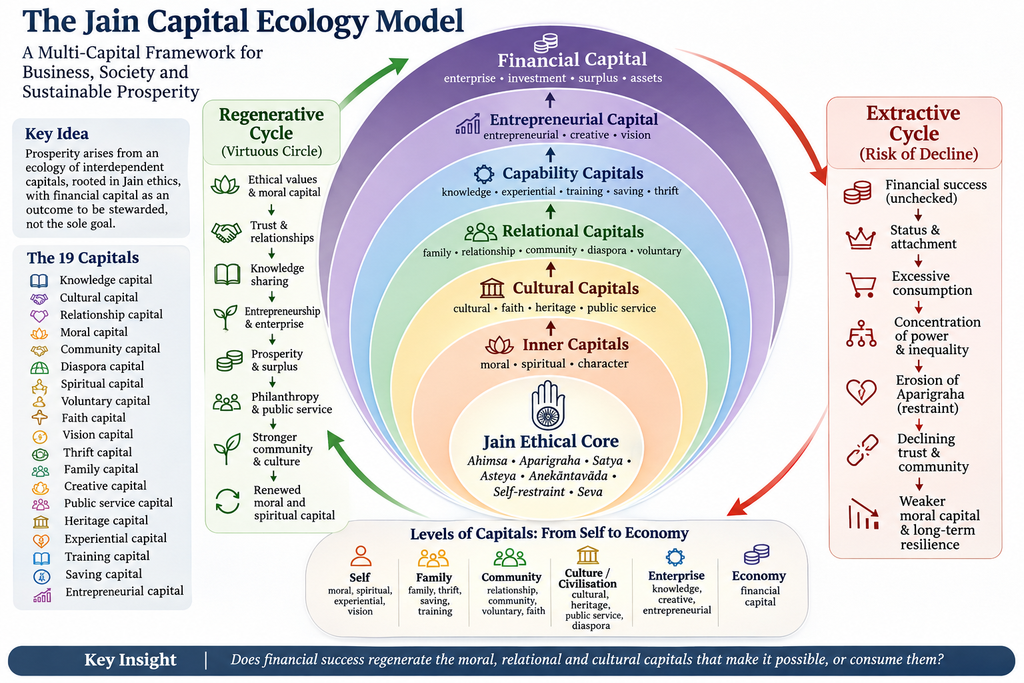
At the centre is the Jain ethical core. These are not merely beliefs; they shape dispositions. Ahimsa encourages awareness of harm. Aparigraha encourages restraint. Satya supports truthfulness. Asteya disciplines appropriation. Anekāntavāda encourages epistemic humility. Self-restraint weakens excessive desire, while seva directs resources toward service.
From this core develops inner capital: moral credibility, spiritual depth, judgement and character. These are difficult to measure but profoundly important because they influence how people behave when rules are incomplete.
Inner capital then supports cultural capital. Faith, heritage, collective memory and traditions of public service give individuals a larger moral framework within which economic action takes place.
Cultural capital supports relational capital. Family, community, diaspora networks, voluntary service and long-term relationships provide trust, mutual support, information and reputation.
Relational capital then strengthens capability capital. Knowledge, experience, saving habits and thrift provide resilience and practical competence.
These capitals create entrepreneurial capacity: the ability to imagine opportunities, innovate, organise resources, take risks and build enterprises.
Only then does substantial financial capital emerge.
The model therefore reverses the conventional assumption:
Finance does not create all the other capitals. Many of the other capitals make finance possible.
There should also be a second arrow running back inward:
FINANCIAL CAPITAL
       │
       ▼
philanthropy • education • heritage • community institutions
       │
       ▼
replenishment of cultural, relational and moral capital
This creates a virtuous circulation model:
Ethics → character → culture → relationships → capability → enterprise → financial surplus → stewardship → renewed moral and community capital
That is potentially the distinctive Jain contribution.
However, the model must also include a degenerative pathway. Financial success does not automatically replenish the system.
Financial Success
       │
       ▼
status • attachment • excessive consumption • concentration of power
       │
       ▼
erosion of Aparigraha and humility
       │
       ▼
declining moral capital
       │
       ▼
weakening trust and community
This makes the model genuinely critical rather than celebratory.
I would therefore portray the whole framework as two possible cycles.
Regenerative Jain Capital Cycle
Moral capital → trust → relationships → knowledge sharing → entrepreneurship → prosperity → philanthropy → stronger community → renewed moral capital
Extractive Capital Cycle
Financial capital → status → accumulation → attachment → inequality → social distance → declining trust → weakening moral capital
The pivotal question becomes:
Does financial success regenerate the capitals that made it possible, or consume them?
That is where Aparigraha becomes especially important. It acts almost like a governor on the system, preventing financial capital from becoming dominant over all other forms of wealth.
A further refinement is to distinguish the capitals by level:
| Level | Capitals |
|---|---|
| Self | Moral, spiritual, experiential, vision |
| Family | Family, thrift, saving, training |
| Community | Relationship, community, voluntary, faith |
| Culture/Civilisation | Cultural, heritage, public-service, diaspora |
| Enterprise | Knowledge, creative, entrepreneurial |
| Economy | Financial capital |
This yields a powerful proposition:
Jain prosperity is best understood not as the accumulation of financial capital, but as the interaction of multiple forms of capital across the self, family, community, culture, enterprise and economy.
And the strongest concluding principle would be:
Healthy prosperity occurs when financial capital remains embedded within, and accountable to, moral, relational, cultural and spiritual capital.