
PROFESSOR ATUL K. SHAH www.atulkshah.co.uk
Globally renowned expert advisor and broadcaster on culture, accounting, finance, business ethics, holistic education and leadership
On hospitality, relationships, and finding yourself in an unfamiliar world
Professor Ivo de Loo reflects on his visit to Jain-Oshwal Centre, London in October 2026
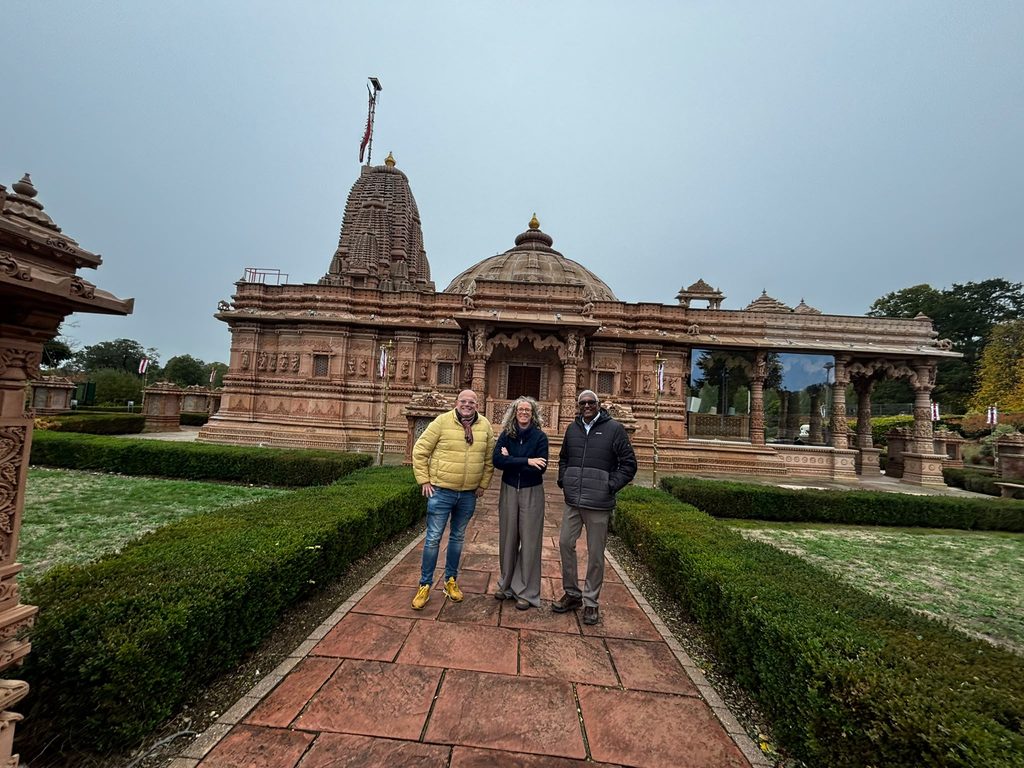
More than two years ago, I met Atul at an accounting conference, where he gave a presentation that resonated with me. He spoke about a world that is constantly becoming, about accounting as something that is itself continuously evolving, and about how we might conduct ourselves in such a world. His message was to remain attentive to the relationships we cherish and those that come into view along the way, and to approach others with nonviolence. Afterwards, I went to meet him, complimented him on his presentation, and we struck up a conversation about Jain religion and philosophy. Before we parted, he invited me to visit a Jain temple. He would arrange the date, and I only had to agree to join him.
More than two years later, the time had finally come. Together with my colleague Margreeth Kloppenburg, who had known Atul for a long, long time; and her husband Michiel, we travelled to the Oshwal Centre, just north of Greater London, where we were welcomed into the Jain community during a nine-day religious observance. This was day 7, which focused on right knowledge.
Our visit began at the temple, where we were given remarkable freedom to explore. Apart from showing respect, there seemed to be few rules for us as visitors. We could wander around, take our time, and discover the place at our own pace. Wherever we went, people were welcoming and cordial, sometimes visibly surprised to encounter three visitors who were clearly unfamiliar with their traditions.
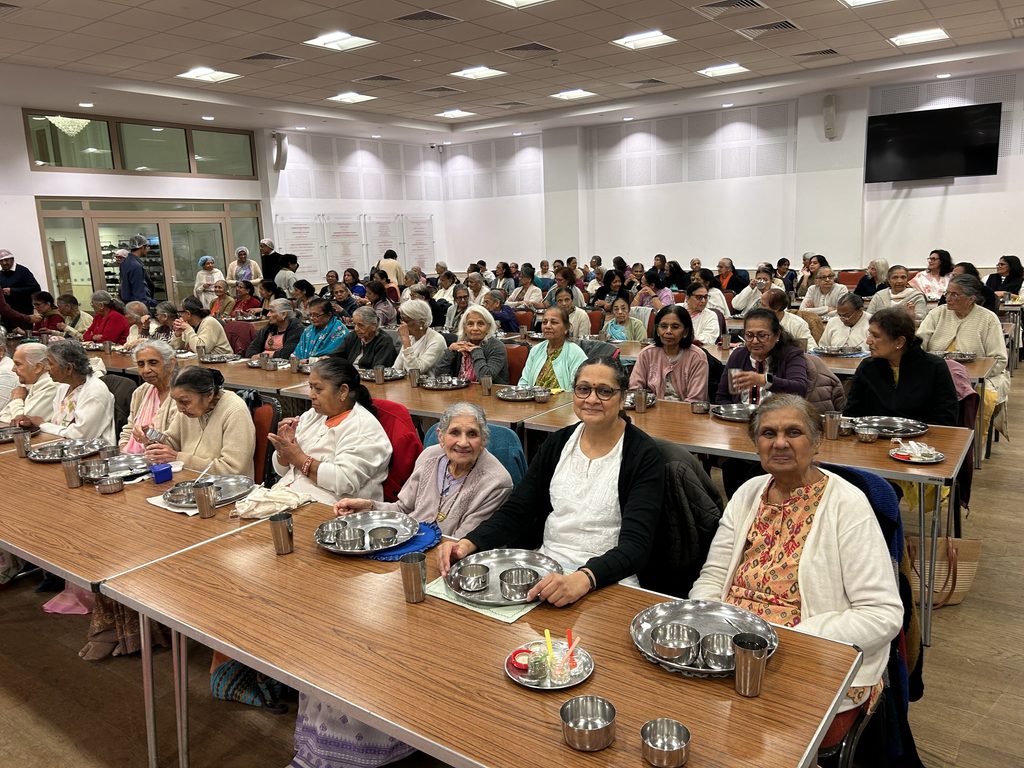
We were then invited to attend a religious discourse and, somewhat unexpectedly, asked to join Atul on stage. He introduced us to the gathering, explained the reason for our visit, and spoke about why Jains have such a strong tradition as accountants. We were also invited to participate in a ritual honouring sacred books, sprinkling a fine, sandy substance over them – it was a reverence of knowledge, something very important in Jain science. We followed the instructions without fully understanding the significance of what we were doing, but nobody seemed particularly concerned about our unfamiliarity. We were simply included in something that clearly mattered to the community.
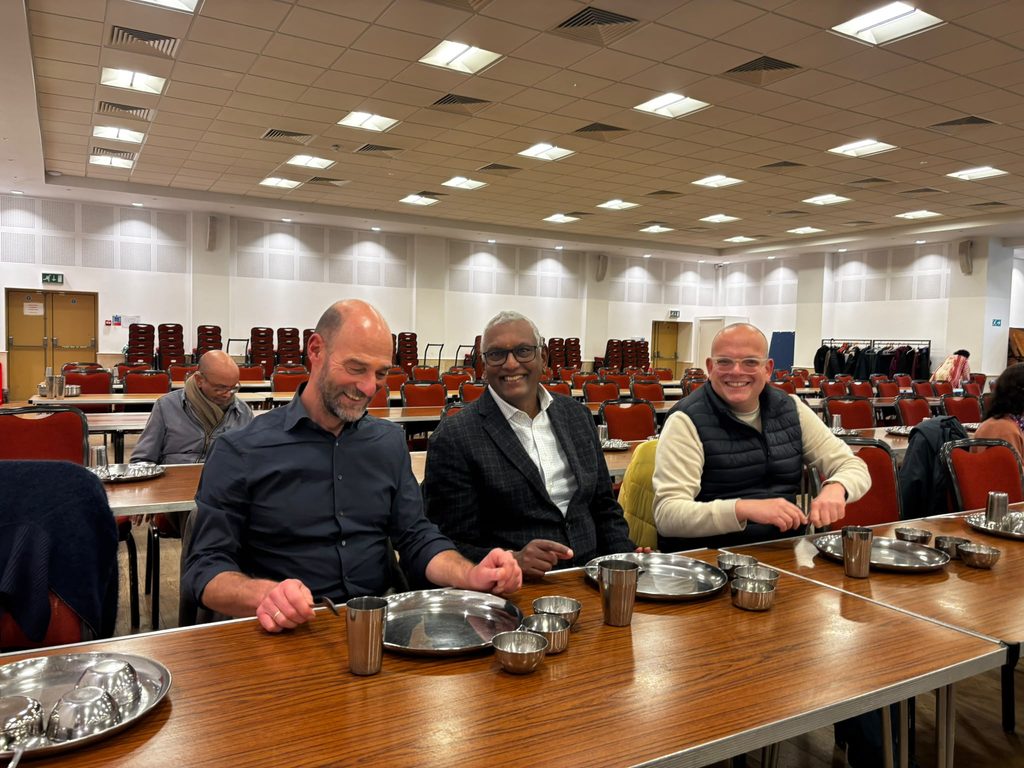
Afterwards, we shared a meal, prepared without the herbs, spices, and other additions we ordinarily associate with Indian food – which happened because of the fasting ritual. Around us, conversations unfolded, people approached one another, and relationships were renewed. Atul was particularly busy, moving between conversations and introductions, seemingly at ease with everything happening around him. Religious observance, hospitality, social encounters, and practical matters were all part of the same occasion, without any apparent need to separate them.
What struck me throughout the visit was the extraordinary cordiality. People approached us spontaneously, curious about our presence and interested in who we were and what had brought us there. We had wonderful conversations, often without the need for much introduction or explanation. We were welcomed into an occasion that had its own history, relationships, and rhythm, and were allowed to find our own place within it.
Looking back, I am struck by how naturally the afternoon connected with Atul’s presentation two years earlier. Relationships were not something to be discussed in the abstract; they were unfolding all around us, through introductions, gestures, conversations, practical arrangements, and the simple act of making room for unexpected visitors. The nonviolence he had spoken about was present in the kindness and consideration with which we were received.
In a world where turmoil seems increasingly ordinary and one crisis follows another, it was heartening to encounter such openness and generosity. We left with only a modest understanding of Jainism, but with a much richer experience of the people who had welcomed us.
What began as a conversation at an accounting conference had become an unexpected encounter with another way of living, and one that will stay with us for a long time.